There’s a question that military historians have been arguing about for over eighty years, and it still
doesn’t have a fully satisfying answer: How do you get caught by surprise twice in the same morning?
On December 7, 1941, Japan attacked Pearl Harbor. The news reached the Philippines—where General
Douglas MacArthur commanded all U.S. Army forces in the region—at roughly 3:40 a.m. local time.
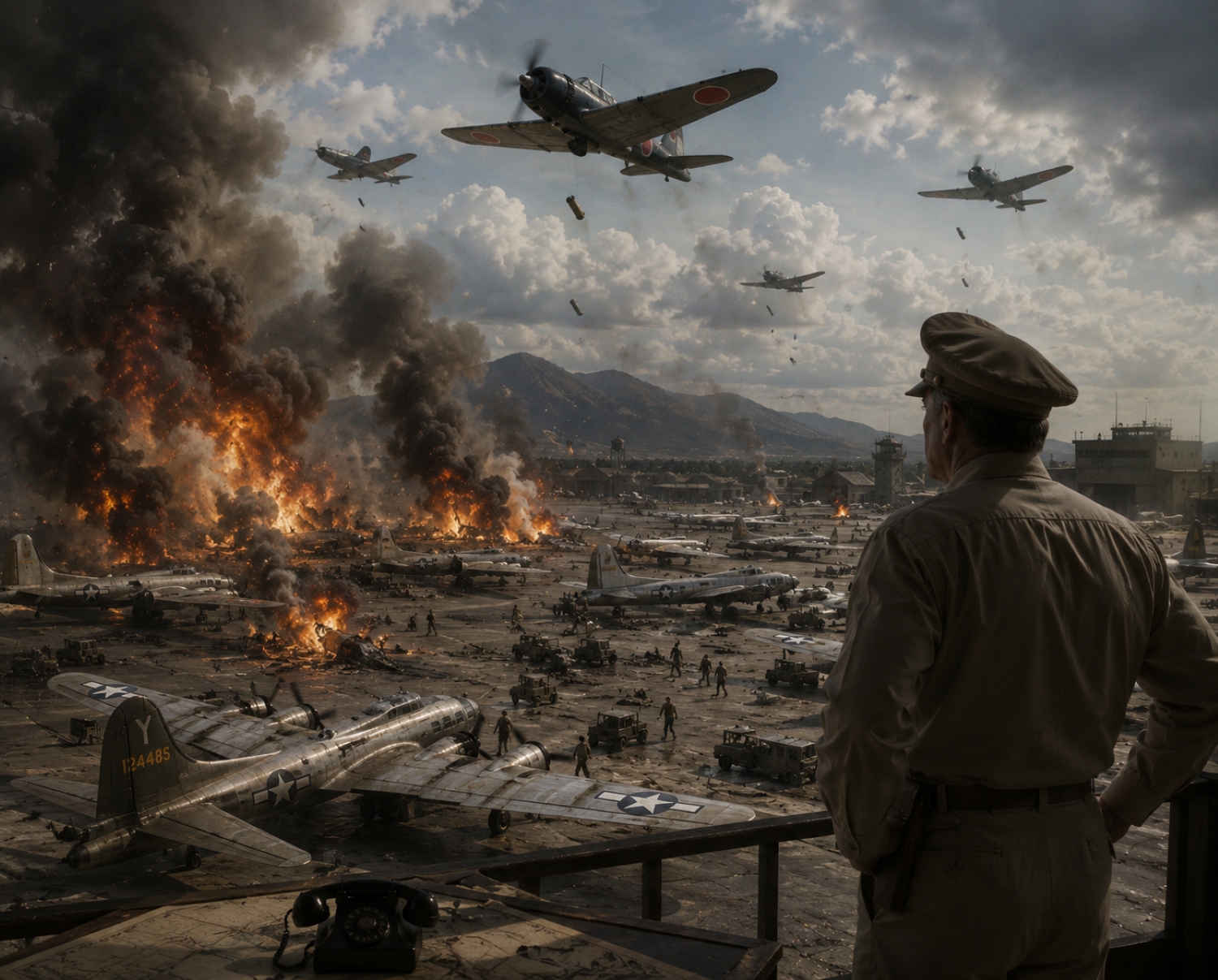
Nine hours later, Japanese bombers appeared over Clark Field, the main American air base on Luzon, and
destroyed most of the Far East Air Force while it sat on the ground. Nearly half of MacArthur’s 35 precious
B-17 Flying Fortresses were wiped out.
The scene was almost identical to what had just happened in Hawaii, except that in the Philippines,
everyone knew it was coming.
That’s the part that makes this story so hard to let go of.
A Warning Nobody Acted On
When MacArthur’s chief of staff woke him with the Pearl Harbor news in the small hours of December 8,
the general’s first move was to rush to his headquarters. His air commander, Major General Lewis Brereton,
was already there with an urgent request: let me launch the B-17s against Japanese airfields in Formosa
before they can hit us.
His logic was straightforward. The American bombers had the range to reach Formosa. All the Japanese
planes that would eventually attack Clark Field were based there. A preemptive strike might catch them on
the ground—the same devastating tactic Japan had just used at Pearl Harbor.
MacArthur said no. Or more precisely, he said nothing, which in military terms amounts to the same thing.
Brereton was turned away by MacArthur’s chief of staff. He tried repeatedly throughout the morning.
Authorization never came. When MacArthur finally gave the green light for a strike at around 10:14 a.m., it
was too late—the planes needed to be refueled and armed, and by 12:35 p.m., the Japanese had arrived.
The bombers that had just landed to refuel were sitting in rows on the tarmac at Clark Field when 53
Japanese aircraft appeared overhead at high altitude. All fighters sent to intercept them found nothing and
came back down. The radar station that detected the incoming raid sent a warning by teletype … but the
operator had gone to lunch. And then the bombs started falling.
It lasted about an hour. When it was over, Clark Field was rubble, and the Far East Air Force had
essentially ceased to exist as a fighting force.
The Question That Never Got a Good Answer
General “Hap” Arnold, commander of the Army Air Force, called Brereton that afternoon and reportedly
asked how in hell an experienced airman could get caught with his planes on the ground nine hours after
Pearl Harbor. It was a fair question.
MacArthur gave several explanations after the war, and none of them held up. He claimed he’d been
ordered not to initiate hostilities, but Washington had told him that Pearl Harbor constituted the “first overt
act” required to authorize offensive action. Japan hadn’t needed to bomb the Philippines specifically before
MacArthur could respond.
He also maintained that he’d already ordered the B-17s dispersed to the safer airfield at Del Monte in
Mindanao, but no records from 1941 support this.
Finally, he insisted he had no knowledge of Brereton’s proposal to strike Formosa—a statement that
conflicts with nearly every other account of that morning.
What historians have pieced together points to something more complicated and, in some ways, more
human than simple deception: a commander paralyzed at a moment of maximum crisis, unable to commit to
a decision, waiting for clarity that never came.
Some of it was genuine confusion about orders. Some of it may have been MacArthur’s instinct to wait
and see. A defensive posture as if he believed that Japan might not strike the Philippines at all, or might not
do so as quickly as it did.
And some of it, frankly, appears to have been overconfidence. MacArthur had spent years building up the
Philippine military. He’d told Washington that the islands could be defended. He may have believed his own assurances more than the situation warranted.
Whatever the reason, the result was catastrophic.
The Asymmetry of Consequence
Here’s the part of this story that still has the power to make you stop and stare: the commanders at Pearl
Harbor lost their careers over what happened on December 7. Admiral Husband Kimmel and General Walter
Short were relieved of command, forced into retirement, and spent the rest of their lives under a cloud.
MacArthur, whose forces suffered a nearly identical disaster nine hours later with the benefit of full warning,
received a promotion eleven days after the attack. He was made a full general on December 19. A few
months later, he received the Medal of Honor.
The disparity wasn’t lost on people at the time. General Marshall, the Army chief of staff, told a reporter
he simply didn’t know how MacArthur had let his planes get caught on the ground. No formal investigation
was ever launched.
The political calculus was too complicated. MacArthur was already being positioned as a symbol of
American resistance in the Pacific, and the fall of the Philippines was going to be ugly enough without
adding a public reckoning over command failures at the top.
The men who paid the real price were the ones on the ground. The Filipino and American troops who
fought for months on the Bataan Peninsula without adequate air cover, without reinforcements, without
enough food—the men who became the Battling Bastards of Bataan—they inherited the consequences of
those nine hours of indecision. On April 9, 1942, about 78,000 of them surrendered to Japan. What followed
was the Bataan Death March.
What History Actually Concludes.
The honest historical verdict is nuanced, but it doesn’t let MacArthur off easily. The Philippines were
probably going to fall regardless. Japan’s strategic position, its air superiority, and the impossibility of
resupply from the American mainland made the long-term outcome nearly inevitable.
Even if Brereton’s B-17s had struck Formosa at dawn on December 8, they likely wouldn’t have changed
the ultimate result—though they might have imposed real costs and delayed Japan’s timetable.
But “probably would have lost anyway” is a very different thing from “the destruction of the Far East Air
Force was unavoidable.” It wasn’t. MacArthur had time. He had options. He had a subordinate commander
actively pleading to use them. The planes that burned on the runway at Clark Field didn’t have to be there,
wingtip to wingtip, waiting.
What the historical record shows most clearly is a man who, at the worst possible moment, failed to
decide. Whether that failure came from confusion, overconfidence, paralysis, or something more deliberate,
the effect was the same: a force that should have been in the air was on the ground when the Japanese
arrived.
It remains one of the most significant command failures in American military history. And unlike Pearl
Harbor, which became a synonym for surprise and shock, the disaster at Clark Field remains strangely
underexamined—a second catastrophe that happened in the shadow of the first, nine hours after there was
any excuse for surprise at all.